
Review
THE EXPERIENCE 2025: TWENTY YEARS OF WORSHIP, BUT IS THE STANDARD OF EXCELLENCE KEEPING PACE WITH THE LEGACY?
A critical examination of musical performances, sound engineering, production shortcomings, artistic innovation, audience experience and what the future should hold for Africa’s biggest gospel music gathering.
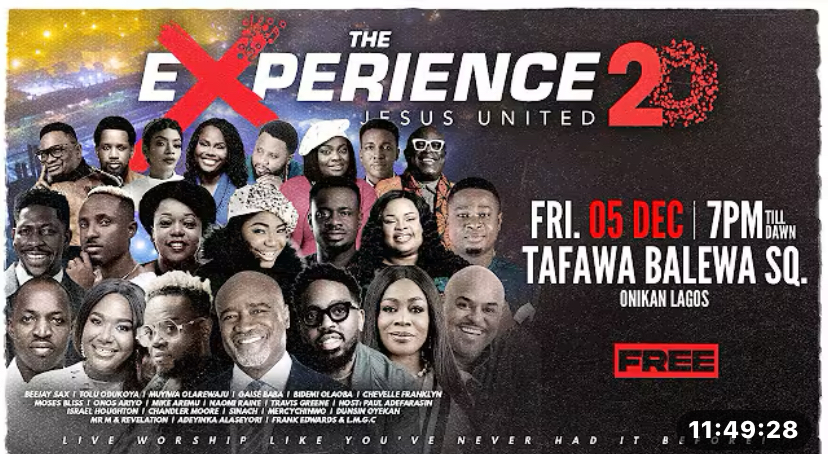
The Experience 2025, the 20th edition of the annual gospel concert organised by House on the Rock, was more than another December gathering. It was a celebration of two decades of an ambitious vision that has grown into one of the most recognisable gospel music platforms in the world.
Held on December 5, 2025, at Tafawa Balewa Square, Lagos, under the theme JESUS UNITED, the landmark edition brought together an impressive collection of Nigerian and international gospel ministers.
From Travis Greene, Israel Houghton, Sinach, Moses Bliss, Dunsin Oyekan, Mercy Chinwo, Naomi Raine and Chandler Moore to Chevelle Franklyn, Frank Edwards, Onos Ariyo, Bidemi Olaoba, Adeyinka Alaseyori, Gaise Baba and Tolu Odukoya, the gathering represented different generations, cultures and musical expressions united by one Christian message.
Twenty years is a significant achievement. It represents consistency, institutional commitment, cultural influence and the ability to sustain an event of enormous logistical and financial demands.
However, anniversaries should not only provide opportunities for celebration. They should also provide opportunities for honest evaluation.
Beyond the impressive lineup, enormous attendance and spiritual significance, there are important questions worth asking.
How well did the 20th edition perform musically? Did its production meet the expectations associated with such a historic milestone? What were the noticeable shortcomings? And more importantly, what should The Experience be doing differently as it enters its next chapter?
These are conversations worth having.
THE QUALITY OF THE CONCERT: TWENTY YEARS DESERVES MORE THAN A CELEBRATION
One of the strongest qualities of The Experience 2025 was its ability to bring together gospel ministers whose musical identities are considerably different.
The event accommodated contemporary American gospel, traditional gospel, Afro-gospel, Caribbean gospel, contemporary worship, indigenous Nigerian praise and choir-driven expressions.
This diversity is one of the most valuable things The Experience has achieved over the years.
Israel Houghton represents a sophisticated contemporary gospel tradition in which musicianship, rhythmic arrangements, vocal harmonies and congregational participation work together.
Travis Greene brings an emotionally expressive worship identity, with considerable emphasis on vocal interpretation, musical progression and dynamic development.
Chandler Moore and Naomi Raine represent contemporary worship’s ability to combine emotional vulnerability, expressive vocals and modern musical arrangements.
Chevelle Franklyn brings Caribbean gospel influences, while Donnie McClurkin’s generation of gospel music is represented through the enduring importance of vocal authority, traditional gospel interpretation and lyrical conviction in the wider musical identity of the event.
The Nigerian contingent offers another dimension.
Nathaniel Bassey represents the importance of instrumental identity, particularly through his trumpet, contemplative vocal approach and atmospheric arrangements.
Dunsin Oyekan brings an extended, spontaneous approach to worship, while Sinach’s songwriting demonstrates the power of memorable melodies and congregational accessibility.
Mercy Chinwo offers expressive vocal delivery, agility and contemporary African gospel influences.
Moses Bliss represents the increasing influence of youthful gospel songwriting, while Gaise Baba introduces an interesting contemporary African expression that connects gospel messaging with modern popular music.
Adeyinka Alaseyori’s performance was characterised by her earthy vocal texture, Yoruba lyrical expressions, energetic delivery and strong call-and-response relationship with the audience.
Her approach placed considerable emphasis on collective participation rather than excessive vocal ornamentation.
Frank Edwards and Onos Ariyo brought their established musical identities to the gathering
Bidemi delivered an energetic, rhythmically driven praise performance, combining his powerful vocal projection, signature “The Bible Says” declarations and spontaneous audience engagement. His musical identity draws strongly from gospel Fuji and highlife influences, brought out the beauty of the talking drum and his Bàtá-style drums: Provided traditional Yoruba rhythmic accents while the Congas and hand percussions reinforced the groove and maintained rhythmic excitement.
What makes these artists valuable is not simply their popularity. It is the different musical experiences they bring.
However, there is an important distinction between assembling exceptional gospel ministers and producing an exceptional musical concert.
The quality of individual performances must be supported by excellent instrumental arrangements, vocal balance, backing-vocal coordination, musical direction and technical execution.
An internationally recognised minister should not automatically translate into an outstanding performance.
The musicianship must justify the reputation.
THE MUSICAL PERFORMANCES: ARE WE GETTING THE BEST OUT OF THE ARTISTS?
One area I believe deserves more attention is the relationship between the artists’ musical abilities and the quality of their live presentations.
The Experience has developed a reputation for assembling some of the most recognisable names in gospel music. However, the next stage of its development should involve more deliberate attention to what each minister brings musically.
Some ministers depend heavily on vocal dynamics and expressive phrasing. Others rely on instrumental arrangements, spontaneous worship, choir interaction, call-and-response or rhythmic intensity.
These different approaches require different musical preparations.
A minister whose music depends on extended instrumental development should have sufficient room for that expression.
A minister whose strength is vocal interpretation should have a properly balanced instrumental mix that allows the audience to appreciate the nuances of the performance.
Similarly, the supporting vocalists should not simply be present to provide background sound. Their harmonies, responses, transitions and overall interpretation should contribute meaningfully to the musical presentation.
I would particularly like to see more intentional musical direction across the different performances.
The Experience should become a place where audiences do not merely hear their favourite gospel songs but also encounter exceptional live arrangements, creative musical interpretations and performances that cannot simply be replicated by playing the original recordings.
That is one of the things that distinguishes an excellent live concert from an ordinary collection of musical performances.
I will reiterate the importance of a well rehearsed stage collaboration between a Nigeria art and the international counterpart.
THE MOST NOTICEABLE SHORTCOMINGS OF THE EXPERIENCE 2025
For an event celebrating its 20th edition, expectations were naturally high. Unfortunately, some aspects of the execution attracted criticism from attendees.
Although the criticisms do not invalidate the overall success of the gathering, they raise important questions about production planning and audience management.
1. SOUND ENGINEERING: THE MOST SIGNIFICANT PRODUCTION CONCERN
Perhaps the most concerning complaint surrounding the 2025 edition was the sound situation at the beginning of the programme.
The concert experienced technical sound difficulties around its scheduled 7 p.m. commencement, with the programme getting underway with over an hour delay, sound problems affected portions of the performances as well.
For a concert with 20 years of production experience, this was particularly disappointing.
Sound is not simply another technical component of a live concert. It is the medium through which the entire musical experience is communicated.
The audience should be able to appreciate the lead vocalist, backing harmonies, instrumental arrangements, percussion, bass lines and other musical details without struggling to distinguish what is happening on stage.
A powerful vocalist cannot fully communicate the intended emotional character of a performance if the vocal mix is compromised.
Similarly, an excellent instrumental arrangement loses much of its value when the different instruments are not properly separated in the mix.
The next edition must prioritise stronger technical backup systems, more comprehensive sound checks, better contingency planning and improved sound distribution across the venue.
At this level, technical failure should be anticipated and prepared for, not simply reacted to when it happens.
1. EXCESSIVE VUVUZELA AND TRUMPET NOISE
This was another issue that attracted considerable public discussion after the concert.
There were excessive vuvuzela and trumpet blowing, particularly where the noise appeared to compete with the actual musical performances, and so it affected the ability to fully participate in worship.
I think this is a particularly important issue because audience participation is part of what makes The Experience exciting.
However, there is a difference between musical participation and uncontrolled noise.
A concert can accommodate energetic expressions of excitement without allowing individual audience members to interfere with the musical presentation.
The organisers should consider clearer audience guidelines and better enforcement of restrictions on disruptive instruments.
The objective should not be to eliminate audience excitement but to ensure that it complements the performances rather than competes with them.
1. CROWD CONTROL AND AUDIENCE BEHAVIOUR
The Experience attracts an enormous congregation, and managing such a crowd requires more than providing security personnel and ushers.
It requires an organised crowd-management structure, clearly defined responsibilities, effective communication and the ability to respond quickly when disturbances occur.
The organisers should pay particular attention to the fact that the facility used for this enormous concert has become smaller as the occasion keeps getting bigger.
The organizers should look for an appropriate measure to salvage this situation as audience movement and control, security visibility, emergency access and the management of disruptive behavior has become increasingly critical.
A worship gathering of this magnitude should make people feel safe enough to participate without unnecessary distractions.
1. PERFORMANCE TIME AND MUSICAL PROGRAMMING
An event featuring several international and Nigerian ministers within one night faces a difficult programming responsibility.
Every artist wants sufficient time to communicate their musical identity, while the organisers must maintain a reasonable programme duration.
However, equal performance time does not necessarily translate into effective musical programming.
Some ministers require extended musical development, spontaneous expressions and congregational engagement.
Others are more effective with shorter, carefully structured presentations.
The organisers should consider the musical requirements of individual performers when allocating time.
The programme should be designed around the musical and emotional journey of the concert, rather than simply distributing minutes among performers.
The audience should experience a carefully developed progression from one performance to another.
THE TWENTIETH ANNIVERSARY: BEYOND THE MUSIC
One of the most important developments surrounding The Experience 2025 was the introduction of the Jesus United musical album.
The project represented an opportunity to extend the event’s musical influence beyond the physical gathering.
More importantly, Pastor Paul Adefarasin announced that proceeds from the album would be directed towards supporting displaced persons across Nigeria.
This was a significant development because it demonstrated how a major gospel music platform could connect musical influence with humanitarian responsibility.
I consider this an important direction worth developing.
The Experience has the audience, visibility and international relationships to become more than an annual concert.
It can become a platform that supports meaningful social intervention, encourages Christian responsibility and provides opportunities for the wider gospel music community to contribute to society.
The next stage should involve greater visibility for such initiatives, with clear communication about their objectives, implementation and impact.
The message of unity should not end when the music stops.
THE SHOW PRODUCTION: WHY THE NEXT LEVEL MUST BE MORE SOPHISTICATED
The production of The Experience deserves a more demanding standard of evaluation.
At this stage, sound engineering, lighting, stage design, broadcast direction, visual presentation and artist coordination should be treated as essential components of the concert’s identity.
The reported sound difficulties at the beginning of the 2025 edition demonstrate why technical preparation must remain a priority.
However, there are other areas where I believe the production can become significantly more sophisticated.
SOUND ENGINEERING AND LIVE MIXING
I would like to see more attention given to the individual musical requirements of each minister.
The sound mix should respect the character of the music being performed.
An Afro-gospel arrangement, traditional gospel presentation and contemporary worship session should not necessarily receive identical mixing treatment.
Vocal clarity, instrumental separation, backing-vocal balance, stage monitoring and consistency across the venue should be non-negotiable.
LIGHTING AND VISUAL STORYTELLING
Lighting should do more than make the stage attractive.
It should contribute to the emotional direction of the performances.
A contemplative worship session should be visually different from an energetic praise presentation.
Lighting changes, LED visuals, camera movements and stage effects should work together to create an immersive musical experience.
The objective should be sophistication without unnecessary distraction.
STAGE DESIGN AND ARTIST TRANSITIONS
The movement between ministers should feel like part of one carefully coordinated production.
Microphone changes, instrumental adjustments, stage personnel, supporting vocalists and incoming performers should be properly coordinated.
There should be minimal unnecessary interruptions.
A concert of this magnitude should not leave audiences experiencing avoidable pauses while technical and stage arrangements are being made.
BROADCAST PRODUCTION
The Experience is not only watched by people at Tafawa Balewa Square.
Its international audience makes the broadcast production an equally important part of the event.
Camera direction, close-ups, wide shots, audience reactions, graphics, audio balance and livestream reliability should receive considerable attention.
A person watching from another country should be able to appreciate the musical quality and atmosphere almost as effectively as someone physically present.
The broadcast should be a world-class production in its own right.
MUSICAL DIRECTION AND REHEARSAL DISCIPLINE
This is one area I would particularly like the organisers to prioritise.
A large gathering of gospel ministers should be supported by a highly coordinated musical structure.
The quality of the backing band, supporting vocalists, instrumentalists and choir should never be treated as secondary.
More intentional rehearsals, creative arrangements, carefully developed medleys and specially prepared musical collaborations could make the event considerably more memorable.
The Experience should be known not only for the people who perform but also for the exceptional musicianship that supports them.
WHAT SHOULD WE EXPECT FROM THE EXPERIENCE 2026?
The 21st edition should represent a new chapter rather than simply another annual gathering.
The announced theme, JESUS, THE ROCK, provides an opportunity to refocus the event on the foundation of the Christian faith.
However, I believe the next edition should be judged by more than its attendance figures or the number of international ministers it attracts.
These are the areas I would particularly like to see developed.
1. A MORE RELIABLE AND SOPHISTICATED TECHNICAL PRODUCTION
The sound difficulties reported in 2025 should become an important lesson.
I would like to see a more comprehensive technical structure, including redundant sound systems, backup power arrangements, independent broadcast audio systems and stronger technical contingency planning.
The production should be prepared for equipment failure, power interruptions and other unexpected technical challenges.
The objective is simple: the audience should experience consistency from the first minute to the last.
1. MORE INTENTIONAL INTERNATIONAL COLLABORATIONS
I would love to see more specially developed collaborations between Nigerian, African and international gospel ministers.
Rather than simply inviting artists to perform individually, the organisers should consider creating musical moments that bring different musical cultures together.
Imagine an African gospel arrangement featuring a Nigerian choir, an American contemporary gospel vocalist and a Caribbean gospel minister.
Such collaborations could introduce exciting musical possibilities.
However, these should be properly rehearsed and creatively arranged, rather than becoming spontaneous combinations without sufficient musical preparation.
1. MORE EXPERIMENTAL MUSICAL ARRANGEMENTS
The Experience should become a platform for musical creativity.
I would like to hear specially developed arrangements, fresh instrumental introductions, creative medleys, extended instrumental passages, sophisticated backing-vocal arrangements and unexpected musical transitions.
There should be performances that make audiences appreciate familiar gospel songs from entirely different musical perspectives.
The objective is not to change the identity of the songs but to demonstrate the possibilities of excellent musicianship.
1. A STRONGER PLATFORM FOR EMERGING GOSPEL TALENTS
The future of gospel music cannot depend exclusively on established names.
There should be deliberate opportunities for emerging gospel ministers, instrumentalists, music directors, songwriters and producers.
I would particularly like to see a structured talent-discovery initiative associated with The Experience.
Such an initiative could identify exceptional young gospel musicians from different African countries and provide opportunities for selected talents to perform on the main platform.
The Experience has the influence to become one of the most important discovery platforms in African gospel music.
1. PROPER USE OF FIREWORKS AND AUDIENCE COMFORT
The use of fireworks should be intentional rather than merely decorative. Fireworks would be most effective when synchronised with significant musical moments, particularly powerful praise sections, major instrumental climaxes, dramatic transitions and the grand finale. A carefully timed display during a particularly explosive musical moment could amplify the audience’s emotional experience and create unforgettable visual memories.
The objective should not simply be to make the sky brighter, but to make the entire concert experience more spectacular without allowing production effects to overshadow the central message of worship.
There should also be clearer guidelines for audience participation, particularly concerning disruptive instruments and inappropriate use of fireworks.
1. MORE CREATIVE STAGE AND VISUAL PRODUCTION
The Experience should explore more sophisticated stage design, LED integration, intelligent lighting, camera technology and carefully coordinated visual storytelling.
However, technology should support the musical presentation rather than become the centre of attention.
The best production is not necessarily the one with the most visual effects. It is the one where every technical element serves the performance.
1. A MORE INTENTIONAL MUSICAL JOURNEY
The sequencing of performances should receive greater attention.
A successful all-night concert should have a carefully considered musical progression.
There should be an understanding of when to build energy, when to create moments of reflection, when to introduce rhythmic excitement and when to allow extended worship.
The audience should experience a musical journey rather than simply watch one minister after another.
This requires stronger collaboration between the artistic director, musical director, stage manager and individual ministers.
1. TURNING THE JESUS UNITED PROJECT INTO A LASTING INITIATIVE
The humanitarian direction associated with the Jesus United album is worth developing beyond the anniversary edition.
I would like to see The Experience establish more visible and sustainable humanitarian projects.
Support for displaced persons, vulnerable communities, emerging gospel musicians and other meaningful social causes could become part of the event’s wider contribution.
This would demonstrate that the influence of gospel music can extend beyond entertainment and worship gatherings into practical expressions of Christian responsibility.
MY CONCLUDING THOUGHT: TWENTY YEARS IS A LEGACY. THE NEXT TEN MUST BE ABOUT EXCELLENCE.
The Experience 2025 was a significant achievement.
Twenty years of bringing different generations, nationalities, denominations and musical identities together in worship is not a small accomplishment.
Its influence on African gospel music, its international visibility and its ability to sustain an enormous annual gathering deserve recognition.
The introduction of the Jesus United album and its associated humanitarian ambition also demonstrated an opportunity to extend the event’s influence beyond the stage.
However, I believe the 20th edition also presented an important reminder: a great reputation does not exempt an event from the responsibility of continuous improvement.
The technical difficulties reported at the beginning of the programme, complaints about excessive audience noise and concerns about crowd behaviour are issues that deserve serious attention.
They should not be dismissed simply because the event was spiritually significant or because the performances were appreciated.
There is a difference between organising a large gospel gathering and producing an exceptional live musical experience.
The latter requires deliberate musical direction, excellent sound engineering, intelligent programming, creative arrangements, disciplined stage management, reliable technology and a genuine commitment to audience experience.
The Experience has already established the platform. It has the audience, the international relationships, the institutional experience and the cultural influence.
What it must continually demonstrate is that its production standards are growing at the same pace as its reputation.
As we look towards 2026 and the theme JESUS, THE ROCK, my expectation is not simply another impressive lineup or another record-breaking attendance figure.
I want to see stronger musicianship, more adventurous musical arrangements, more meaningful international collaborations, greater technical reliability, improved audience management and a production that reflects the global status of the event.
I want to see an event where the quality of the sound is as impressive as the quality of the singers, where the supporting musicians receive as much attention as the lead performers, and where every production decision contributes meaningfully to the overall experience.
Most importantly, I want to see The Experience continue to demonstrate that gospel music can be spiritually powerful, artistically sophisticated and professionally produced without compromising its central message.
Twenty years have established the legacy.
The next chapter must establish an even higher standard.
Because when an event becomes this influential, excellence should no longer be something it occasionally achieves. It should be the standard audiences have every reason to expect.
And that, in my opinion, is what The Experience 2026 should represent: not merely another gathering in the presence of God, but another significant advancement in the quality, creativity and global influence of African gospel music.